Photography
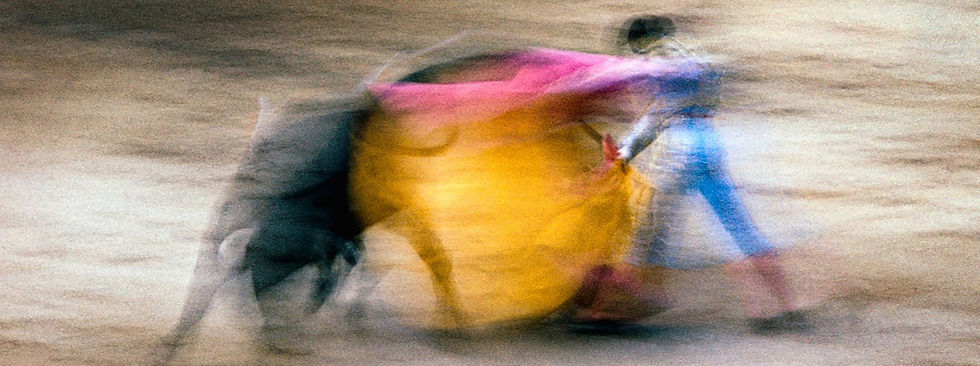
Ernst Haas La Suerte de Capa, Pamplona, Spain 1956
Ernst Haas: Photography as a language of transformation
From perception to experience, a visual language to inhabit
Ernst Haas's work marks a decisive break in the history of photography: it shifts the image from the descriptive register to that of perceptual transformation. Photographing no longer consists of recording reality, but of revealing a sensitive, inner, often elusive dimension.
This approach finds profound resonance in the works of Saul Leiter and André Kertész, who, each in their own way, contribute to making photography an autonomous poetic language.
This brings us closer to the concept of the imperfect photograph, which I've often discussed. Here, the rules of composition disappear; movement, layering, and the interplay of colors take control of the photographic act. This approach results in a photograph where the documentary aspect fades, giving way to visual expression where emotions prevail.
An expressive approach to contemporary photography
In contrast to a documentary tradition centered on fidelity to reality, Haas offers a vision where the image becomes interpretation, emotion and visual poetry.
In a world saturated with images, his approach recalls an essential truth: photography is not just a technical tool, but an artistic language capable of transforming perception.
Seeing things differently

On the left, the image by Ernst Haas: a bullfighting scene dissolved in movement, where the bull, the bullfighter, and the cape become flows of color and energy. Nothing is fixed, everything is in flux. Reality is transfigured, not described, but felt.
On the right, an AI-generated image: sharp, precise, almost surgical. Every detail is legible: the matador's costume, the bull's muscular tension, the texture of the sand. Here, the scene is perfectly captured, controlled, stabilized.
This is the image Haas could have captured with a modern, high-performance camera…
…but precisely, that's not the one he chose to do.
Because what this comparison reveals is not a technical evolution, but a difference in position in relation to reality.
Blur vs. precision
Two photographic languages
At Haas: ambiguity is intentional
In AI imagery: sharpness is performance
Haas's photography does not suffer from a lack of technology. It is an aesthetic choice: he rejects clarity in order to achieve a deeper form of truth.
AI imagery, meanwhile, embodies a contemporary vision where technical power allows us to see everything, but poses an essential question: does seeing more mean understanding more?
The event vs. the experience
AI image: documents an event (a bullfight)
Haas: creates a visual experience
In Haas's work, the scene is no longer a narrative. It becomes tension, rhythm, vibration. The subject disappears in favor of a sensation.
Time
AI: a frozen moment, perfectly captured
Haas: duration, flow, passage
Haas's photography does not capture a moment: it condenses several moments into a single perception.
What AI cannot replace
This juxtaposition creates a tension between two eras: a photograph born of constraint, interpretation, and risk, and an image resulting from total control, precision, and simulation.
The Haas image reveals one thing above all: technical power is no substitute for vision. If Ernst Haas had had access to a high-performance camera, he might have been able to produce an image similar to the one on the right. But it is more likely that he would have chosen not to.
Because his work does not seek to see better, it seeks to see differently.


De la captation à l’interprétation
Chez Haas, voir n’est pas enregistrer. L’appareil capte, mais c’est le regard qui construit. L’image devient une traduction d’une expérience, et non une preuve du réel.
Cette posture rejoint la sensibilité de André Kertész, dont les images révèlent une poésie du quotidien, et celle de Saul Leiter, où le monde apparaît filtré, fragmenté, souvent partiellement dissimulé.
Voir devient alors un acte indirect, une manière de laisser émerger le réel plutôt que de le saisir frontalement.
La primauté du regard
Photographie et subjectivité
La pensée de Haas repose sur une distinction essentielle : voir n’est pas enregistrer.
L’appareil capte, mais c’est le photographe qui construit l’image. Cette posture inscrit la photographie dans un champ profondément subjectif, où chaque image devient le reflet d’une sensibilité. Elle rejoint, en filigrane, les réflexions de Susan Sontag sur la photographie comme interprétation du réel plutôt que reproduction neutre.
Ici, l’image ne documente rien, elle propose une expérience.
La couleur comme matière émotionnelle
Vers une photographie sensorielle
Avec Haas, la couleur cesse d’être descriptive. Elle devient vibration, tension, énergie.
Elle ne sert pas à reproduire fidèlement le monde, mais à en traduire une intensité. Rouge incandescent, jaunes saturés, bleus profonds : chaque tonalité agit comme une force émotionnelle autonome. La photographie devient alors proche d’une écriture picturale, où la couleur structure l’image autant que le sujet.
Le mouvement et la durée
Dépasser l’instant figé
Contrairement à la tradition de l’instant décisif associée à Henri Cartier-Bresson, Haas explore une temporalité étendue.
Le flou, la dérive des formes, la dissolution du détail introduisent une dimension nouvelle : celle de la durée. L’image ne capture plus un moment précis, mais suggère un passage, une continuité.
Le geste photographique devient ainsi proche de la mémoire, fragmentaire, mouvante, instable.
L’abstraction comme révélation
Une esthétique de la suggestion
En poussant la photographie vers l’abstraction, Haas libère l’image de son obligation de lisibilité.
Les formes se simplifient, les contours se dissolvent, les sujets deviennent presque méconnaissables. Ce qui subsiste, c’est une organisation de lignes, de masses et de couleurs. Une structure visuelle qui agit directement sur la perception.
Cette approche entre en résonance avec la sensibilité poétique de André Kertész, où l’image dépasse la narration pour atteindre une forme d’écriture silencieuse.
L’imperfection comme langage
Esthétique de l’incertain
Chez Haas, les limitations techniques ne sont jamais corrigées, elles sont intégrées.
Flou, surexposition, déséquilibre chromatique : autant d’éléments qui deviennent constitutifs de l’image. Loin de la perfection formelle, son travail ouvre un espace où l’incertitude devient fertile.
L’image gagne en densité précisément parce qu’elle échappe à la maîtrise totale.
Le spectateur comme co-créateur
Une image ouverte
Privée de sens univoque, la photographie de Haas engage activement le regardeur.
Elle ne livre pas de message, mais crée une tension, une énigme. Le spectateur est invité à projeter ses propres associations, ses propres émotions. L’image devient un espace de résonance.
Ainsi, la photographie ne se clôt pas dans sa forme : elle se prolonge dans l’expérience de celui qui la regarde.
La photographie comme langage
Apprendre à parler en images
Penser la photographie comme une langue, c’est reconnaître qu’elle possède :
-
un vocabulaire
-
une grammaire
-
une syntaxe
-
une voix
Chez Ernst Haas, cette idée est implicite : maîtriser la photographie, c’est apprendre à articuler ces éléments pour produire du sens.
Les “mots” de la photographie
Comme une langue repose sur des mots, la photographie repose sur des éléments fondamentaux :
-
la lumière
-
la couleur
-
la ligne
-
la forme
-
la texture
-
le mouvement
-
le cadre
Ces éléments sont les unités de sens de l’image.
Le vocabulaire visuel
Dans cette perspective, le photographe ne photographie pas des objets, il manipule un lexique visuel au moyen d’une grammaire propre à la photographie.
Chez Saul Leiter, par exemple :
-
une tache de couleur derrière une vitre devient un mot
-
une silhouette partielle devient une phrase incomplète
Chez André Kertész :
-
une ombre, une distorsion, un angle inattendu deviennent des signes porteurs de sens
Chez Ernst Haas :
-
le flou n’est pas un accident, c’est une règle choisie
-
la couleur n’est pas décorative, elle structure la phrase visuelle
Cette grammaire permet de donner cohérence et direction à l’image.
Composition, relations de plans, tensions visuelles organisent ces éléments en une phrase visuelle.
-
Haas construit des phrases dynamiques, vibrantes
-
Leiter fragmente, interrompt, suggère
-
Kertész équilibre avec subtilité
L’image ne décrit pas, elle n’est pas documentaire, elle énonce avec son bagage d’émotions.
Construire une “phrase visuelle”
La syntaxe, c’est la manière dont les éléments s’enchaînent pour produire du sens.
Chez Haas, cela se traduit par :
-
l’ordre des plans
-
la relation entre premier plan et arrière-plan
-
les interruptions (cadres, obstacles, flous)
Chez Saul Leiter :
-
la syntaxe est fragmentée
-
la phrase est souvent incomplète, suggérée
Chez André Kertész :
-
la syntaxe est subtile, presque invisible
-
elle repose sur des équilibres délicats
L’image devient une phrase ouverte, jamais totalement explicite.
La couleur et la lumière
Entre vibration et retenue
Haas libère la couleur de sa fonction descriptive pour en faire une matière expressive, intense, presque musicale.
Chez Saul Leiter, la couleur est plus feutrée, filtrée par des surfaces, des reflets. Elle ne s’impose pas, elle affleure.
Chez André Kertész, la lumière devient écriture subtile, faite de nuances et de silences.
Mouvement et temporalité
Du flux à la suspension
Haas introduit une photographie du mouvement et de la durée. Le flou devient un outil pour traduire le passage du temps.
Chez Leiter, le temps semble suspendu.
Chez Kertész, il est discret, presque imperceptible.
Dans les trois cas, la photographie dépasse l’instant pour devenir une expérience temporelle subjective.
L’abstraction du réel
De la figure à la sensation
En poussant l’image vers l’abstraction, Haas libère la photographie de son obligation de lisibilité.
-
Leiter fragmente le visible
-
Kertész le déplace subtilement
-
Haas le transforme par la couleur et le mouvement
L’image ne montre plus : elle suggère, évoque, fait ressentir.
Imperfection et incertitude
Une esthétique du vivant
Flou, obstruction, déséquilibre deviennent des éléments constitutifs :
-
Haas: énergie du flou
-
Leiter: voile et filtration
-
Kertész: déformation poétique
L’image échappe à la maîtrise totale et gagne en profondeur.
Le spectateur comme espace de résonance
Une langue ouverte
Comme toute langue vivante, la photographie ne se réduit pas à un sens unique.
Elle :
-
suggère
-
laisse place
-
engage le regardeur
Le spectateur devient celui qui complète la phrase visuelle.
André Kertész and the intuition of the gaze

The origins of sensitive photography that would lead to Ernst Haas
These four images by André Kertész reveal the extent to which his work foreshadows certain fundamental intuitions that Ernst Haas would later develop: photography as perception, as visual rhythm, as poetic experience rather than a simple description of reality. Where Haas would introduce movement, color, and blur as an expressive language, Kertész already laid the foundations for a gaze that transforms the everyday into visual writing.
The double portrait
In the first image, a swimmer's face appears dissolved, traversed by a distortion that fragments the very identity of the subject. This photograph directly announces Haas's cherished idea: reality is not fixed. The portrait ceases to be a faithful representation and becomes: unstable perception, fragmented presence, and mental vibration. Here we find an essential intuition: the image can express more by relinquishing absolute sharpness. The image offers us a fragmentation of reality.
Umbrellas seen from above
In the second image, the silhouettes carrying umbrellas become almost like notes on a musical score. The subject is no longer really the street or the passersby: it's the rhythm, the repetition of forms, the movement of the gaze, the tension between lines and masses. This approach resonates deeply with Haas, for whom photography possesses its own syntax and musicality.
The child and his shadow
The third photograph is perhaps the one that engages most directly with Haas. The child's body, propelled into motion, seems almost to merge with its shadow. The scene shifts from documentary to a form of visual theater. As in Haas's work, movement becomes emotion, time becomes perceptible, and reality glides toward poetry. The shadow acts here as an invisible double, transforming an ordinary scene into a mental image.
The snowy square
In the final image, the snow transforms the urban space into a graphic composition. Traces on the ground become lines, gestures, and visual calligraphies. It is a form of abstraction of the world. The city ceases to be an identifiable place and becomes almost an abstraction. Reality is reduced to rhythms, contrasts, and visual structures that directly foreshadow Haas's expressive photography.
An invisible lineage
Long before Ernst Haas's chromatic and dynamic explorations, André Kertész introduced a photography based on suggestion, rhythm, and the perceptual transformation of reality. His images shift the gaze from the subject to the very experience of seeing. The everyday becomes abstraction, movement becomes sensation, and photography a silent form of visual poetry.
Reference : Why every photographer needs André Kertész
Saul Leiter's photographic vision

In Saul Leiter's work, Ernst Haas's influence is not manifested in formal imitation, but in a shared deep conviction: photography should not simply show the world, but transform it into a sensory experience.
Where Haas explores the vibration of movement and chromatic power, Leiter chooses withdrawal, intimacy, and obstruction. Reality always appears partially veiled, as if glimpsed through memory or dream.
The red umbrella
In the first image, the snow absorbs almost all presence. The world seems reduced to a range of grays and diffuse whites, until this intense, fragile, almost unreal red umbrella emerges. As with Haas, color ceases to be descriptive; it becomes an event. Leiter uses color here as a poet would use a word isolated in silence. The red does not document the scene; it creates emotional tension.
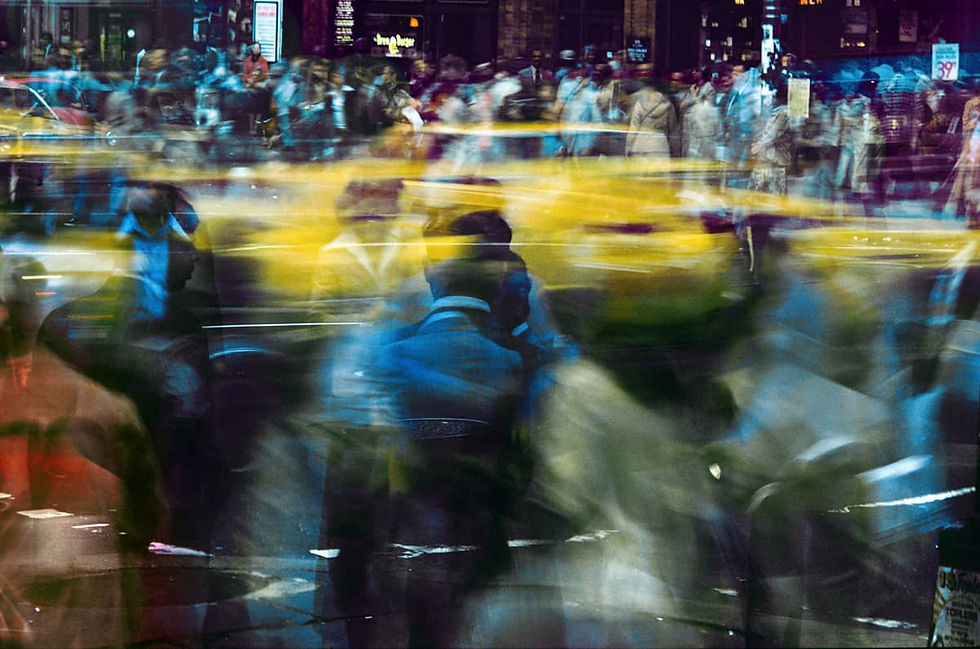
The blurry taxi
The second image reveals a more direct kinship with Haas. The vehicle, dissolved in movement, traverses the image like a luminous trail. The blur does not indicate a technical weakness; it becomes a way of making the passage of time visible. But unlike Haas, whose movement often possesses an expansive energy, Leiter maintains a certain restraint: the world remains silent, the figures remain distant, the movement itself seems stifled by the snow and the urban atmosphere.
The figure behind the glass
The third image perhaps condenses Leiter's language in its purest form. The textured glass acts as a filter between the viewer and the subject. The body is no longer truly visible: it becomes a diffuse, almost ghostly presence. Here, Leiter echoes a fundamental intuition he shared with Haas: photography sometimes gains depth when it forgoes clarity. The subject is not presented directly; it must be sought, intuited, imagined. The warm light behind the glass transforms the scene into a painting of perception rather than a photographic document.
A photograph of the withdrawal
In these three images, Saul Leiter constructs an aesthetic of incompleteness: obstructed surfaces, fragmented forms, isolated colors, partial movements. Reality is never fully accessible. And it is precisely in this distance that poetry is born. Photography becomes less a tool for description than a space for perception and memory.
Dialogue with Imaginary Dance and Rhythmic Resonance

The body as language, following in the footsteps of Ernst Haas
Imaginary dance : the dissolution of the body and the emergence of gesture. The body slips away; the human figure is no longer defined by its contours, but by its momentum. The white veil, stretched in the movement, becomes an extension of the gesture, almost a trace of time itself. The blur is not a loss of information: it is the very substance of the image.
Rhythmic resonance : The body as pulse. The body asserts itself differently, anchored in a more structured tension. The presence of the guitar introduces an essential dimension: the rhythm becomes visible. The gesture is no longer merely fluid, it is pulsating, almost musical.
In these images, the body ceases to be a subject and becomes a vehicle. Like Ernst Haas, Claude Gauthier does not seek to fix reality, but to reveal its internal dynamics. Blur becomes language, light becomes matter, and gesture, a form of thought in motion. Between apparition and pulsation, these works inscribe photography in a space where seeing is no longer enough: one must feel.
In Imaginary Dance and Rhythmic Resonance, this conception of photography as a language takes on an embodied form:
the body becomes a word
Light becomes a syntax
the movement becomes a phrase
Danse imaginaire explores disappearance, veiling, and the near-appearance of Leiter's restraint.
Rhythmic resonance unfolds an energy, a pulse echoing Haas.
In both cases, the image does not represent the body: it speaks through it. The image gives it a new identity based not on a precise representation, but through a blur associated with movement, which is brought out in the moment when the body gives itself to its art, while creating a visual signature.
Conclusion
Inhabiting the language of the visible
Far from being a simple technical medium, photography appears here as a language in its own right.
With Ernst Haas, Saul Leiter and André Kertész, it becomes:
an act of perception
a visual writing
a form of thought
Photography is about learning to speak with light and, sometimes, to say what words cannot tell us.

The work of Ernst Haas
Austrian-born American photographer Ernst Haas (1921–1986) occupies a central place in the evolution of photography toward an expressive language. A member of Magnum Photos from the 1950s, he quickly distinguished himself through his innovative approach to color, which he liberated from its descriptive function to make it an emotional material. In contrast to a documentary tradition based on sharpness and the decisive moment, Haas explored blur, movement, and fragmentation to convey a more fluid and subjective perception of time. His images, often bordering on abstraction, transform reality into a visual experience, where light, color, and rhythm take precedence over the subject. His work marks a lasting break: photography is no longer merely a recording of the world, but a form of writing, a language to be mastered in order to express an inner vision.