Photography
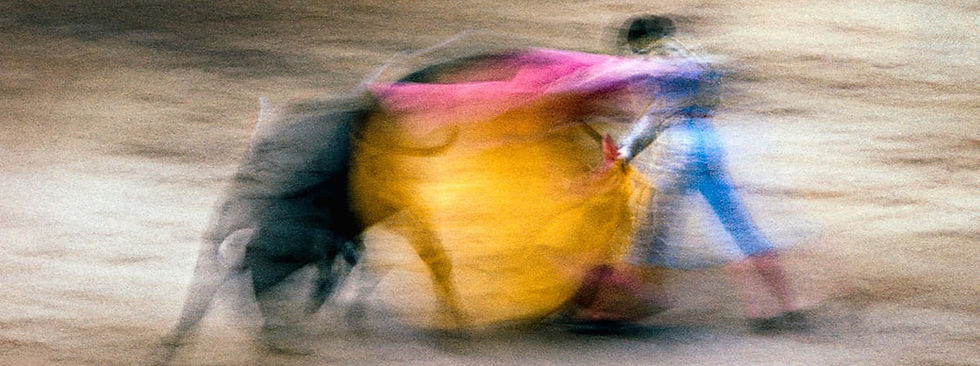
Ernst Haas La Suerte de Capa, Pamplona, Spain 1956
Ernst Haas: Photography as a language of transformation
From perception to experience, a visual language to inhabit
Ernst Haas's work marks a decisive break in the history of photography: it shifts the image from the descriptive register to that of perceptual transformation. Photographing no longer consists of recording reality, but of revealing a sensitive, inner, often elusive dimension.
This approach finds profound resonance in the works of Saul Leiter and André Kertész, who, each in their own way, contribute to making photography an autonomous poetic language.
This brings us closer to the concept of the imperfect photograph, which I've often discussed. Here, the rules of composition disappear; movement, layering, and the interplay of colors take control of the photographic act. This approach results in a photograph where the documentary aspect fades, giving way to visual expression where emotions prevail.
An expressive approach to contemporary photography
In contrast to a documentary tradition centered on fidelity to reality, Haas offers a vision where the image becomes interpretation, emotion and visual poetry.
In a world saturated with images, his approach recalls an essential truth: photography is not just a technical tool, but an artistic language capable of transforming perception.
Seeing things differently

On the left, the image by Ernst Haas: a bullfighting scene dissolved in movement, where the bull, the bullfighter, and the cape become flows of color and energy. Nothing is fixed, everything is in flux. Reality is transfigured, not described, but felt.
On the right, an AI-generated image: sharp, precise, almost surgical. Every detail is legible: the matador's costume, the bull's muscular tension, the texture of the sand. Here, the scene is perfectly captured, controlled, stabilized.
This is the image Haas could have captured with a modern, high-performance camera…
…but precisely, that's not the one he chose to do.
Because what this comparison reveals is not a technical evolution, but a difference in position in relation to reality.
Blur vs. precision
Two photographic languages
At Haas: ambiguity is intentional
In AI imagery: sharpness is performance
Haas's photography does not suffer from a lack of technology. It is an aesthetic choice: he rejects clarity in order to achieve a deeper form of truth.
AI imagery, meanwhile, embodies a contemporary vision where technical power allows us to see everything, but poses an essential question: does seeing more mean understanding more?
The event vs. the experience
AI image: documents an event (a bullfight)
Haas: creates a visual experience
In Haas's work, the scene is no longer a narrative. It becomes tension, rhythm, vibration. The subject disappears in favor of a sensation.
Time
AI: a frozen moment, perfectly captured
Haas: duration, flow, passage
Haas's photography does not capture a moment: it condenses several moments into a single perception.
What AI cannot replace
This juxtaposition creates a tension between two eras: a photograph born of constraint, interpretation, and risk, and an image resulting from total control, precision, and simulation.
The Haas image reveals one thing above all: technical power is no substitute for vision. If Ernst Haas had had access to a high-performance camera, he might have been able to produce an image similar to the one on the right. But it is more likely that he would have chosen not to.
Because his work does not seek to see better, it seeks to see differently.


From capture to interpretation
For Haas, seeing is not recording. The camera captures, but it is the eye that builds. The image becomes a translation of an experience, not proof of reality.
This stance echoes the sensibility of André Kertész, whose images reveal a poetry of everyday life, and that of Saul Leiter, in which the world appears filtered, fragmented and often partly hidden.
Seeing then becomes an indirect act, a way of letting reality emerge rather than seizing it head-on.
The primacy of the gaze
Photography and subjectivity
Haas's thinking rests on an essential distinction: seeing is not recording.
The camera captures, but it is the photographer who builds the image. This stance places photography in a deeply subjective field, where each image becomes the reflection of a sensibility. Implicitly, it echoes the reflections of Susan Sontag on photography as an interpretation of reality rather than a neutral reproduction.
Here, the image documents nothing; it offers an experience.
Colour as emotional matter
Toward a sensory photography
With Haas, colour ceases to be descriptive. It becomes vibration, tension, energy.
It does not serve to reproduce the world faithfully, but to convey an intensity. Incandescent red, saturated yellows, deep blues: each tone acts as an autonomous emotional force. Photography then comes close to a painterly writing, in which colour structures the image as much as the subject does.
Movement and duration
Going beyond the frozen instant
Unlike the tradition of the decisive moment associated with Henri Cartier-Bresson, Haas explores an extended temporality.
Blur, the drift of forms and the dissolution of detail introduce a new dimension: that of duration. The image no longer captures a precise moment but suggests a passage, a continuity.
The photographic gesture thus comes close to memory: fragmentary, shifting, unstable.
Abstraction as revelation
An aesthetic of suggestion
By pushing photography toward abstraction, Haas frees the image from its obligation to be legible.
Forms are simplified, contours dissolve, subjects become almost unrecognizable. What remains is an organization of lines, masses and colours: a visual structure that acts directly on perception.
This approach resonates with the poetic sensibility of André Kertész, in which the image goes beyond narrative to reach a form of silent writing.
Imperfection as language
An aesthetic of uncertainty
For Haas, technical limitations are never corrected; they are integrated.
Blur, overexposure, chromatic imbalance: all become constituent elements of the image. Far from formal perfection, his work opens a space where uncertainty becomes fertile.
The image gains density precisely because it escapes total control.
The viewer as co-creator
An open image
Deprived of a single meaning, Haas's photography actively engages the viewer.
It does not deliver a message but creates a tension, an enigma. Viewers are invited to project their own associations and emotions. The image becomes a space of resonance.
Thus the photograph does not close itself off in its form: it continues in the experience of the person looking at it.
Photography as language
Learning to speak in images
To think of photography as a language is to recognize that it has:
-
a vocabulary
-
a grammar
-
a syntax
-
a voice
For Ernst Haas, this idea is implicit: mastering photography means learning to articulate these elements to produce meaning.
The "words" of photography
Just as a language rests on words, photography rests on fundamental elements:
-
light
-
colour
-
line
-
shape
-
texture
-
movement
-
the frame
These elements are the units of meaning of the image.
Visual vocabulary
From this perspective, the photographer does not photograph objects; he handles a visual lexicon by means of a grammar specific to photography.
In Saul Leiter's work, for example:
-
a patch of colour behind a window becomes a word
-
a partial silhouette becomes an unfinished sentence
In André Kertész's work:
-
a shadow, a distortion, an unexpected angle become meaningful signs
In Ernst Haas's work:
-
blur is not an accident but a chosen rule
-
colour is not decorative; it structures the visual sentence
This grammar gives the image coherence and direction.
Composition, relationships between planes and visual tensions organize these elements into a visual sentence.
-
Haas builds dynamic, vibrant sentences
-
Leiter fragments, interrupts, suggests
-
Kertész balances with subtlety
The image does not describe and is not documentary; it speaks with its baggage of emotions.
Building a "visual sentence"
Syntax is the way the elements follow one another to produce meaning.
For Haas, this translates into:
-
the order of planes
-
the relationship between foreground and background
-
interruptions (frames, obstacles, blur)
For Saul Leiter:
-
the syntax is fragmented
-
the sentence is often incomplete, suggested
For André Kertész:
-
the syntax is subtle, almost invisible
-
it rests on delicate balances
The image becomes an open sentence, never fully explicit.
Colour and light
Between vibration and restraint
Haas frees colour from its descriptive function and turns it into an expressive, intense, almost musical matter.
For Saul Leiter, colour is more muted, filtered through surfaces and reflections. It does not impose itself; it surfaces.
For André Kertész, light becomes a subtle writing, made of nuances and silences.
Movement and temporality
From flow to suspension
Haas introduces a photography of movement and duration. Blur becomes a tool for conveying the passage of time.
With Leiter, time seems suspended.
With Kertész, it is discreet, almost imperceptible.
In all three cases, photography goes beyond the instant to become a subjective experience of time.
The abstraction of the real
From figure to sensation
By pushing the image toward abstraction, Haas frees photography from its obligation to be legible.
-
Leiter fragments the visible
-
Kertész subtly displaces it
-
Haas transforms it through colour and movement
The image no longer shows: it suggests, evokes, makes us feel.
Imperfection and uncertainty
An aesthetic of the living
Blur, obstruction and imbalance become constituent elements:
-
Haas: the energy of blur
-
Leiter: veiling and filtering
-
Kertész: poetic distortion
The image escapes total control and gains in depth.
The viewer as a space of resonance
An open language
Like any living language, photography cannot be reduced to a single meaning.
It:
-
suggests
-
leaves room
-
engages the viewer
The viewer becomes the one who completes the visual sentence.
André Kertész and the intuition of the gaze

The origins of sensitive photography that would lead to Ernst Haas
These four images by André Kertész reveal the extent to which his work foreshadows certain fundamental intuitions that Ernst Haas would later develop: photography as perception, as visual rhythm, as poetic experience rather than a simple description of reality. Where Haas would introduce movement, color, and blur as an expressive language, Kertész already laid the foundations for a gaze that transforms the everyday into visual writing.
The double portrait
In the first image, a swimmer's face appears dissolved, traversed by a distortion that fragments the very identity of the subject. This photograph directly announces Haas's cherished idea: reality is not fixed. The portrait ceases to be a faithful representation and becomes: unstable perception, fragmented presence, and mental vibration. Here we find an essential intuition: the image can express more by relinquishing absolute sharpness. The image offers us a fragmentation of reality.
Umbrellas seen from above
In the second image, the silhouettes carrying umbrellas become almost like notes on a musical score. The subject is no longer really the street or the passersby: it's the rhythm, the repetition of forms, the movement of the gaze, the tension between lines and masses. This approach resonates deeply with Haas, for whom photography possesses its own syntax and musicality.
The child and his shadow
The third photograph is perhaps the one that engages most directly with Haas. The child's body, propelled into motion, seems almost to merge with its shadow. The scene shifts from documentary to a form of visual theater. As in Haas's work, movement becomes emotion, time becomes perceptible, and reality glides toward poetry. The shadow acts here as an invisible double, transforming an ordinary scene into a mental image.
The snowy square
In the final image, the snow transforms the urban space into a graphic composition. Traces on the ground become lines, gestures, and visual calligraphies. It is a form of abstraction of the world. The city ceases to be an identifiable place and becomes almost an abstraction. Reality is reduced to rhythms, contrasts, and visual structures that directly foreshadow Haas's expressive photography.
An invisible lineage
Long before Ernst Haas's chromatic and dynamic explorations, André Kertész introduced a photography based on suggestion, rhythm, and the perceptual transformation of reality. His images shift the gaze from the subject to the very experience of seeing. The everyday becomes abstraction, movement becomes sensation, and photography a silent form of visual poetry.
Reference : Why every photographer needs André Kertész
Saul Leiter's photographic vision

In Saul Leiter's work, Ernst Haas's influence is not manifested in formal imitation, but in a shared deep conviction: photography should not simply show the world, but transform it into a sensory experience.
Where Haas explores the vibration of movement and chromatic power, Leiter chooses withdrawal, intimacy, and obstruction. Reality always appears partially veiled, as if glimpsed through memory or dream.
The red umbrella
In the first image, the snow absorbs almost all presence. The world seems reduced to a range of grays and diffuse whites, until this intense, fragile, almost unreal red umbrella emerges. As with Haas, color ceases to be descriptive; it becomes an event. Leiter uses color here as a poet would use a word isolated in silence. The red does not document the scene; it creates emotional tension.
The blurry taxi
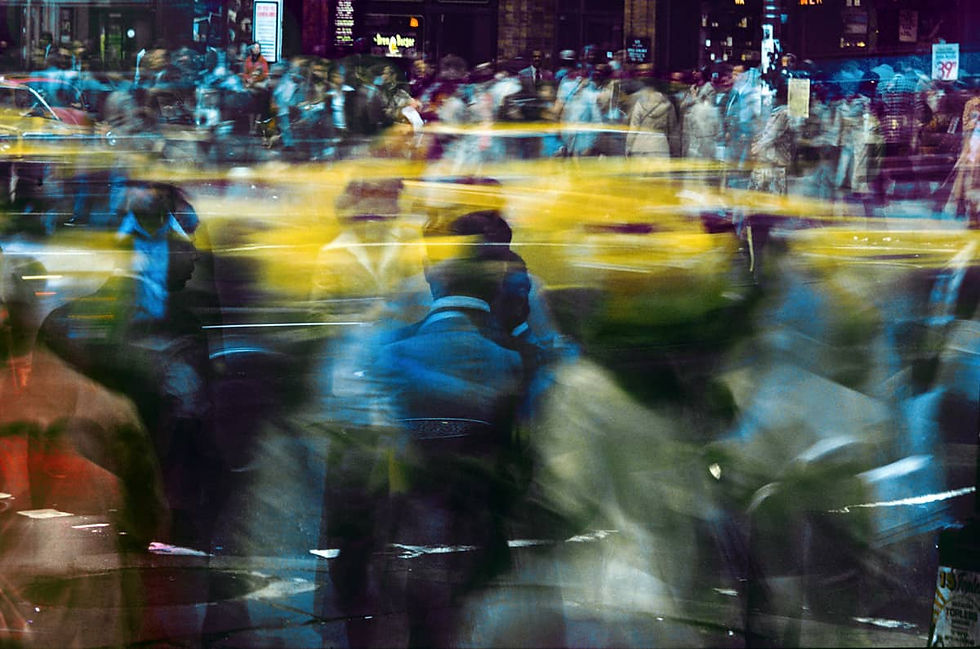
The second image reveals a more direct kinship with Haas. The vehicle, dissolved in movement, traverses the image like a luminous trail. The blur does not indicate a technical weakness; it becomes a way of making the passage of time visible. But unlike Haas, whose movement often possesses an expansive energy, Leiter maintains a certain restraint: the world remains silent, the figures remain distant, the movement itself seems stifled by the snow and the urban atmosphere.
The figure behind the glass
The third image perhaps condenses Leiter's language in its purest form. The textured glass acts as a filter between the viewer and the subject. The body is no longer truly visible: it becomes a diffuse, almost ghostly presence. Here, Leiter echoes a fundamental intuition he shared with Haas: photography sometimes gains depth when it forgoes clarity. The subject is not presented directly; it must be sought, intuited, imagined. The warm light behind the glass transforms the scene into a painting of perception rather than a photographic document.
A photograph of the withdrawal
In these three images, Saul Leiter constructs an aesthetic of incompleteness: obstructed surfaces, fragmented forms, isolated colors, partial movements. Reality is never fully accessible. And it is precisely in this distance that poetry is born. Photography becomes less a tool for description than a space for perception and memory.
Dialogue with Imaginary Dance and Rhythmic Resonance

The body as language, following in the footsteps of Ernst Haas
Imaginary dance : the dissolution of the body and the emergence of gesture. The body slips away; the human figure is no longer defined by its contours, but by its momentum. The white veil, stretched in the movement, becomes an extension of the gesture, almost a trace of time itself. The blur is not a loss of information: it is the very substance of the image.
Rhythmic resonance : The body as pulse. The body asserts itself differently, anchored in a more structured tension. The presence of the guitar introduces an essential dimension: the rhythm becomes visible. The gesture is no longer merely fluid, it is pulsating, almost musical.
In these images, the body ceases to be a subject and becomes a vehicle. Like Ernst Haas, Claude Gauthier does not seek to fix reality, but to reveal its internal dynamics. Blur becomes language, light becomes matter, and gesture, a form of thought in motion. Between apparition and pulsation, these works inscribe photography in a space where seeing is no longer enough: one must feel.
In Imaginary Dance and Rhythmic Resonance, this conception of photography as a language takes on an embodied form:
the body becomes a word
Light becomes a syntax
the movement becomes a phrase
Danse imaginaire explores disappearance, veiling, and the near-appearance of Leiter's restraint.
Rhythmic resonance unfolds an energy, a pulse echoing Haas.
In both cases, the image does not represent the body: it speaks through it. The image gives it a new identity based not on a precise representation, but through a blur associated with movement, which is brought out in the moment when the body gives itself to its art, while creating a visual signature.
Conclusion
Inhabiting the language of the visible
Far from being a simple technical medium, photography appears here as a language in its own right.
With Ernst Haas, Saul Leiter and André Kertész, it becomes:
an act of perception
a visual writing
a form of thought
Photography is about learning to speak with light and, sometimes, to say what words cannot tell us.

The work of Ernst Haas
Austrian-born American photographer Ernst Haas (1921–1986) occupies a central place in the evolution of photography toward an expressive language. A member of Magnum Photos from the 1950s, he quickly distinguished himself through his innovative approach to color, which he liberated from its descriptive function to make it an emotional material. In contrast to a documentary tradition based on sharpness and the decisive moment, Haas explored blur, movement, and fragmentation to convey a more fluid and subjective perception of time. His images, often bordering on abstraction, transform reality into a visual experience, where light, color, and rhythm take precedence over the subject. His work marks a lasting break: photography is no longer merely a recording of the world, but a form of writing, a language to be mastered in order to express an inner vision.