The suspended momentum, duality according to Nietzsche
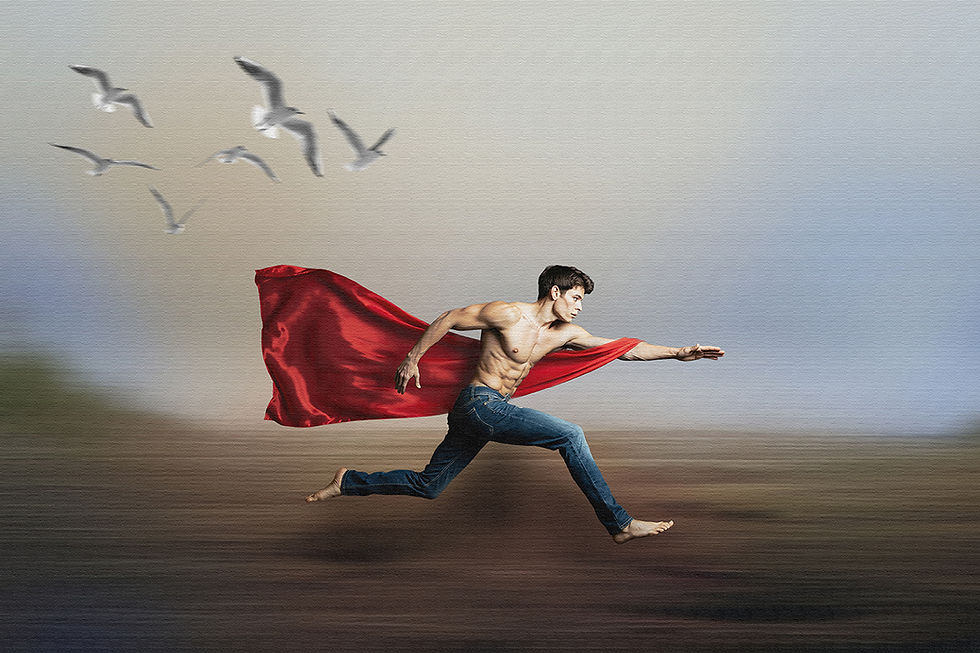
The image depicts Lorenzo in a state of projection, captured in a moment of suspension that defies any narrative resolution. It is neither a departure nor an arrival, but an in-between, a passage where the subject seems literally torn from the ground. The stark background, the unstable horizon, and the blurred ground all contribute to isolating the figure and tipping it into another, almost abstract, temporality.
The model's precise and deliberate pose suggests a desire for control. The outstretched arm, a direct extension of the gaze, inscribes the movement within an intentional trajectory. This formal clarity, this legibility of gesture, recalls an aesthetic of measure and balance that finds its echo in the classical tradition. The body is structured, organized, and legible.
However, this coherence is disrupted by the presence of the red cape. It acts as an autonomous force. Its unfolding defies the logic of the gesture, introducing a dimension of overflow, dispersion, even resistance. Where the body seeks direction, the cape introduces indeterminacy. It makes visible an energy that cannot be contained within form.
It is in this coexistence of two regimes that the image finds its depth. The tension between the rigor of the gesture and the instability of the fabric evokes the duality conceived by Friedrich Nietzsche between the Apollonian and the Dionysian. The former organizes, structures, and gives form; the latter overflows, dissolves, and throws into crisis any attempt at stabilization. The work keeps them in friction.
The birds in the background introduce a subtle yet significant counterpoint. Their presence suggests an immediate, organic freedom that contrasts with the visible effort of the human body. Yet their blurriness relegates them to a kind of unreality, as if this freedom remained inaccessible, or at least irreducible to human experience. Humans do not fly: they attempt, they project, they invent the conditions for their own momentum.
The image stands apart from traditional representations of the hero. It doesn't offer a contemporary version, but rather a deconstruction. The subject is not a finished model, but a body in tension, traversed by contradictory forces. He does not dominate the world: he confronts it, in a state of precarious equilibrium.
In this sense, the work contributes to a broader reflection on the body as a site of experience rather than an object of representation. The body is not celebrated here for its form alone, but for its capacity to carry a dynamic, to embody a process. It becomes the vehicle for questioning the very possibility of self-definition, of projecting oneself, of transforming oneself.
Searching for symbolism
The life force, the conquest of self: the man in the making
The body is propelled forward, in a suspended, almost unreal run. His gesture evokes a tension between desire and fulfillment; the outstretched arm becomes a line of sight, an inner direction.
The myth of the hero (contemporary reinterpretation)
The red cape is a key element, a reference to modern superheroes, without being a complete costume, the broken myth, the link between an ancient hero and the ordinary man.
Freedom and weightlessness
The body seems to float, detached from the ground, without anchoring, creating a sensation of liberation from constraints.
The wind, the fabric, the transformation
The red cape acts as an extension of the body, amplifying movement and materializing invisible energy (wind, speed, momentum).
The birds (symbolic counterpoint)
In the background, the birds introduce a second interpretation: they embody natural freedom, but they are blurry, out of reach.
Red: desire, power, vulnerability
The color of the cape expresses passion, energy, life force, but also fragility, an emotional burden that one carries behind.
Time suspended
The image captures an impossible moment, a frozen jump, a stopped trajectory, a pivotal moment, between what has been left behind and what has not yet been reached.


Comments