When photography engages in dialogue with Antiquity
- Claude Gauthier
- Nov 8, 2025
- 2 min read

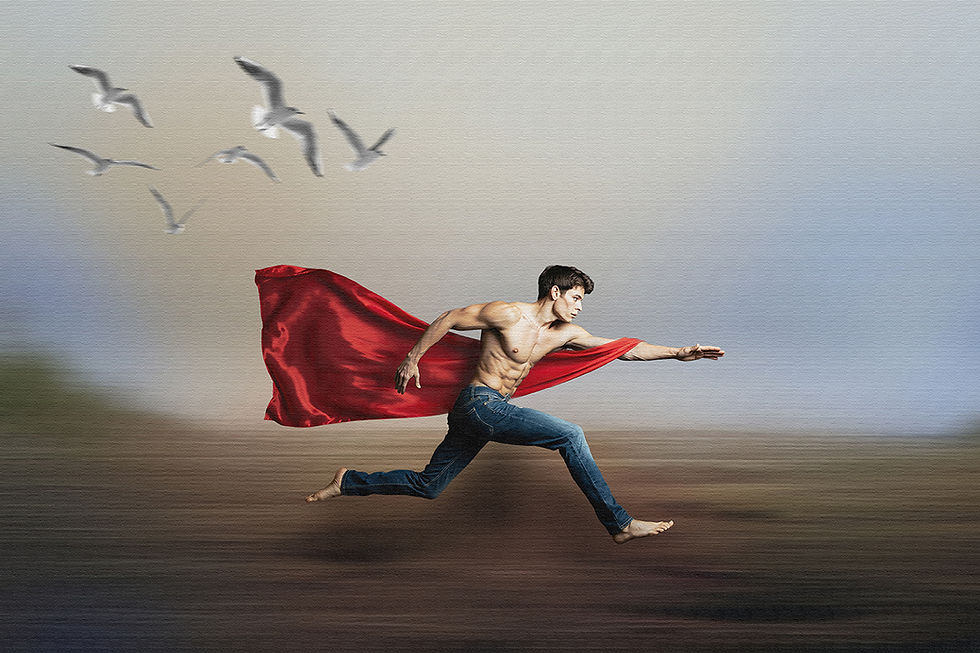
In this image of dancer Luca Giaccio captured by David Vance in 2015, the photographer openly draws on a classical visual repertoire whose origins predate the advent of photography by several centuries. He is part of a long tradition in which the male body becomes a vehicle for harmony, balance, and expressive tension, inherited as much from Greek sculpture as from Neoclassicism.
Echoes of ancient Greek sculpture
The model's posture (weight on one leg, arm extended forward, rear leg raised) directly echoes the canons of Hellenistic statuary. It reflects the bodily geometry of the Discophora and the athletes of Polyclitus, characterized by a keen sense of balance and internal tension. Further comparisons can be drawn with the dynamic figures of Euphranor or Lysippus, whose works combined movement and grace.
In a later style, but one deeply inspired by ancient Greece, the kinship is evident with Giambologna's Flying Mercury, whose figure rests on a single point of support, rear leg raised, body twisted, and upward thrust. This sculpture appears to be a direct source for Vance, so striking is the gestural similarity.

Neoclassical gentleness
Beyond the pose, the soft lighting, the golden skin, and the delicate modeling of the body recall the works of Antonio Canova: Perseus, Orpheus, or Adonis. In Canova's work, the masculine ideal is manifested in an almost choreographed harmony, a blend of gentleness and anatomical perfection that Vance transposes here into a contemporary photographic language.
Another particularly close reference is found in the bronzes of Edgar Degas, notably Grande arabesque, troisième temps . The similarity of the balance on one leg, the stretched back leg and the extended arm testifies to the same gestural register, on the border between sculpture and dance.

The legacy of classical dance
The pose also corresponds to an arabesque as found in classical ballet: all the weight resting on one leg, the other extended behind, the opposite arm creating a precise counterweight. This emblematic posture runs through the history of the stage, from academic dance to modern experiments. One thinks in particular of Nijinsky in Afternoon of a Faun , where the body becomes both sign and movement.

David Vance's neo-academicism
David Vance is known for his aesthetic, which draws on references to Greek sculpture, neoclassicism, and contemporary dance. In several series, he creates "living statues" in the studio, sculpting light as a plastic material.
This photograph by Luca Giaccio fits perfectly into this approach. It restores to the male body a timeless dimension, situated at the intersection of myth, dance and classical iconography, a way for Vance to re-actualize, through light and pose, a thousand-year-old visual heritage.


Comments