Encounter — The sensuality of the gaze
Updated: 16 hours ago

Encounter explores sensuality through movement, light, and gaze. Rather than presenting the body as a mere object of contemplation, this short video gradually transforms the relationship between the model, the camera, and the viewer. What begins as observation becomes an encounter.
At first, the model appears in profile. He seems to belong to his own space, as if he were still unaware of our presence. Against a profoundly dark background, the light isolates the face, shoulder, and torso. It never fully reveals the body: it outlines certain parts while others return to shadow.
Model Andrew Milton's photos allowed artificial intelligence to create this video
There is something sculptural about this first appearance. The profile, the relative stillness, and the strong contrast evoke our way of observing a classical sculpture: we discover its contours and volumes as the model's form transforms. Like Michelangelo's Dying Slave, suspended between surrender and tension, the sculpture offers us its volumes. Encounter introduces what marble cannot produce: time.
From sculpture to the living body
Here is an earlier representation of the male body. Michelangelo's Dying Slave , sculpted between 1513 and 1515 for the project of the tomb of Pope Julius II, offers a particularly disturbing expression of it.

In Michelangelo's work, the body seems suspended between surrender and tension. The head tilts, the torso stretches, an arm folds toward the face. Despite the figure's physical power, something is relaxed. The marble, a still and cold material, paradoxically gives the impression of a body still filled with breath. The Louvre, moreover, emphasizes the ambiguity of this figure, which appears less to be dying than to be surrendering to a deep sleep.
It is this ambiguity that interests me in the comparison with Encounter .
My model doesn't replicate Michelangelo's pose. The connection lies elsewhere: in this way of allowing the body to oscillate between strength and vulnerability, between exposure and surrender. The lighting sculpts the torso and face in the darkness, much like the sculptor brings forth form from marble. The body isn't simply shown; it reveals itself gradually.
But the video introduces an element absent from the sculpture: time.
The model moves. He abandons his profile pose, slowly turns his body and face, and then meets the camera. The sculptural form becomes a presence. What we could contemplate from a distance suddenly becomes aware of our gaze.
Sensuality does not reside solely in beauty or in the display of the male body. It appears in this oscillation between surrender and awareness, between the body offered to the gaze and the subject who, suddenly, looks back.
In Michelangelo's work, we walk around the sculpture to discover it. In Encounter , it is the model that turns towards us.
From observation to encounter
The photographic portrait traditionally establishes an asymmetrical relationship. The photographer looks; the model is looked at. Later, the viewer in turn inherits this privileged position and observes the image.
In Encounter , the movement gradually disrupts this relationship.
As the model moves from profile to face the camera, his presence changes. When his eyes finally meet the lens, we are no longer simply watching him.
He looks at us in turn.
It is precisely in this reversal that sensuality takes root.
It doesn't rely on an explicitly seductive pose. The gesture remains understated, almost minimalist. Sensuality arises instead from anticipation: the slow rotation of the body, the movement of light on the skin, and finally, the appearance of the gaze directed towards us.
The distance between the subject and the observer suddenly seems to shrink.
This is the very origin of the title Encounter : it is no longer just about seeing a body, but about experiencing the fleeting encounter.
Sensuality as suggestion
Showing a body and producing a sensual image are two different things.
Sensuality often resides in what remains uncertain: between revelation and concealment, proximity and distance, a given gaze and a returned gaze.
In Encounter , darkness therefore plays as important a role as light. What is not shown leaves room for the imagination.
The body appears in fragments. First a shoulder, then the curve of the torso, the outline of a face. Light reveals.
The movement adds another dimension: waiting.
Unlike still photography, video gives us a sense that a transformation is about to occur. Another gesture, another expression, a new configuration of body and light are about to appear.
Part of the sensuality lies precisely in this anticipation.
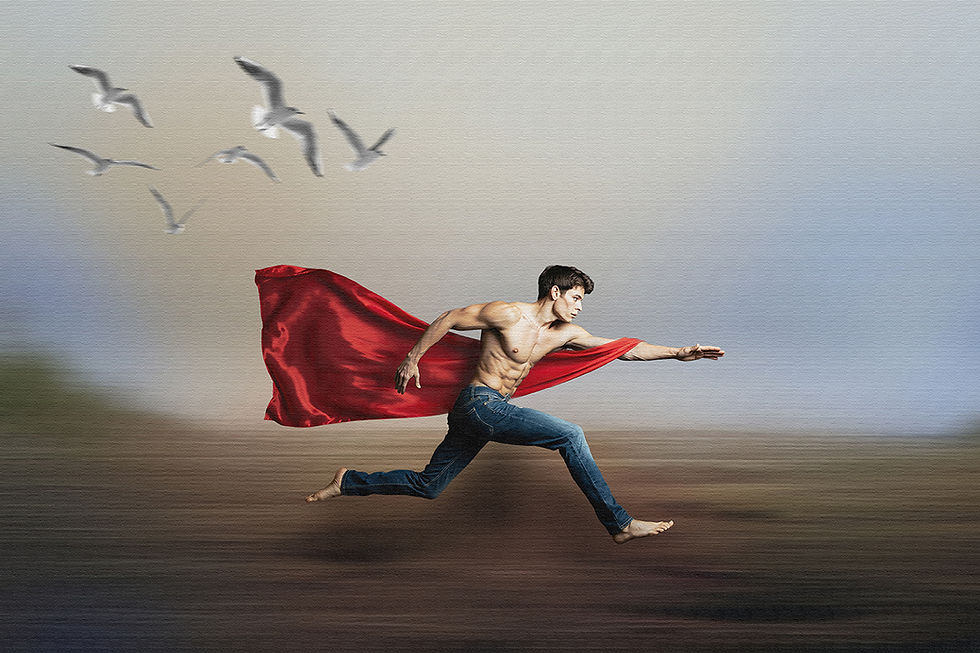
Photo collection of model Andrew Milton
The intimacy of the camera
The camera occupies a special position in Encounter . It is both observer and participant.
When the model's eyes meet the lens, we are no longer mere voyeurs. That gaze unmasks us. True sensuality is born here, in this loss of control, where the viewer himself becomes vulnerable.
This is one of the fascinating phenomena of portraiture. A relationship that occurred between a photographer and a model at a specific moment can then be reactivated by each person who looks at the image.
The video amplifies this feeling even further because we are witnessing the birth of the gaze.
We see someone first.
Then, gradually, this person seems to see us.
From the body to presence
Ultimately, Encounter is perhaps less about the male body than about presence.
The body provides the form. Light gives it volume. Movement introduces time. The gaze creates the encounter.
These elements gradually transform contemplation into a form of reciprocity. The viewer is invited to get closer, but the distance is never entirely eliminated.
And this distance is essential.
Because sensuality exists precisely in this fragile space between proximity and separation, between exposure and mystery, between the desire to look and the sudden realization that we, too, are being looked at.
Five centuries apart, The Dying Slave and Encounter in Motion pose the same question: at what point do we stop simply looking at a body and start feeling the presence of the one who inhabits it?
Note on the Creative Process
The video presented in this project was created using artificial intelligence, with Kling, from photographs taken by the author. The text of this blog also benefited from a critical review and suggestions for improvement by Gemini. The ideas, reflections, and interpretations developed in this article, as well as the photographic concepts and processes behind the images, are the result of the author’s own work and artistic practice.


Comments